
Global Smart Water Management Market: Top Companies, Trends, and Future Outlook
Author:
Intellectual Market Insights Research
Published Date:
25 Sep 2026
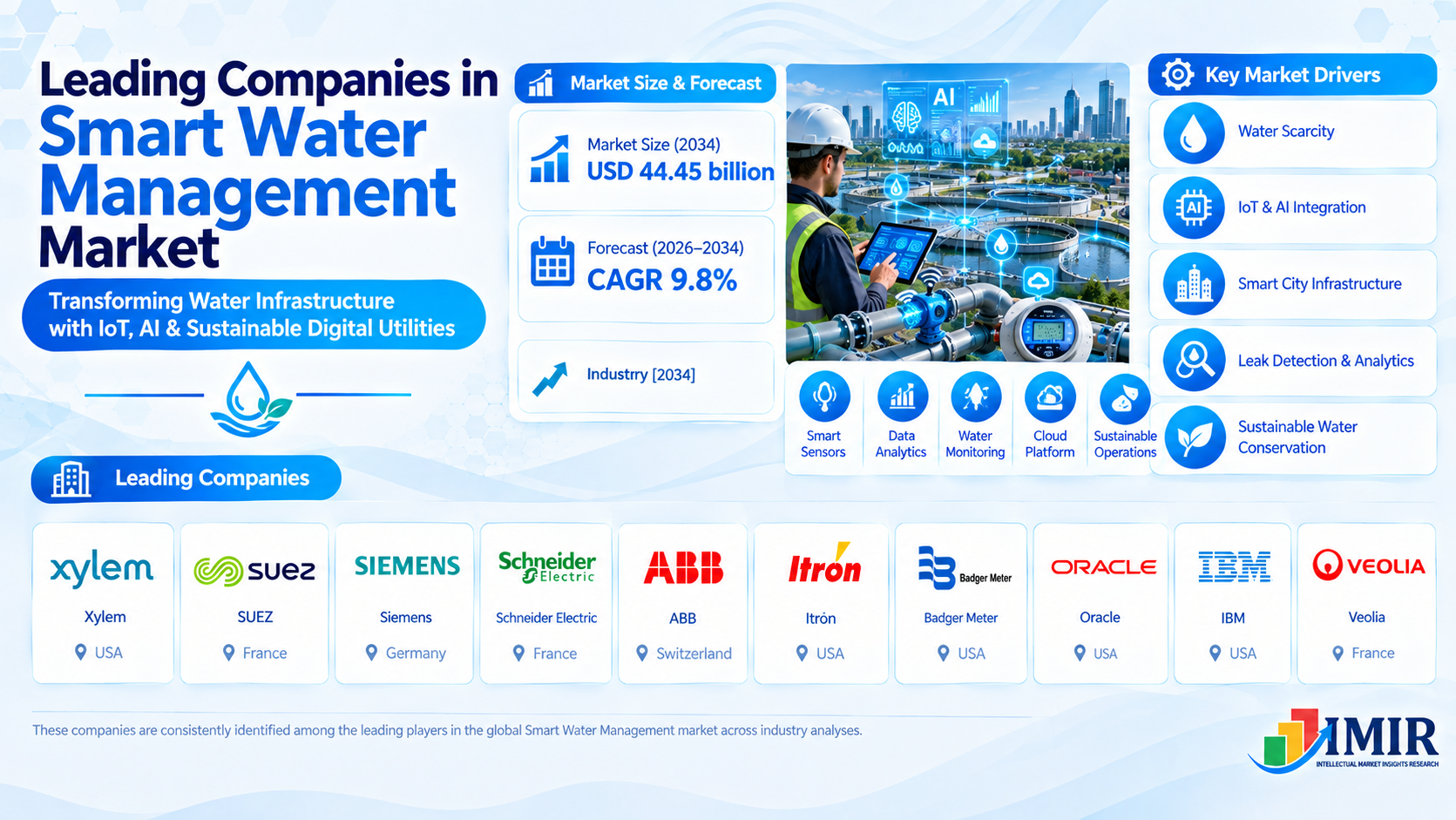
Global Smart Water Management Market: Top Companies, Trends, and Future Outlook
Introduction
Smart water management uses IoT-enabled sensors, advanced metering infrastructure (AMI), AI-driven analytics, and cloud-based software to monitor, control, and optimize water distribution, consumption, and treatment across municipal, industrial, and residential settings. As water utilities worldwide confront aging infrastructure, a global non-revenue water rate estimated at roughly 35% (water lost to leaks, theft, and metering inaccuracies), and mounting pressure from climate-driven water scarcity, smart water management has moved from a niche efficiency upgrade to a frontline strategy for utility resilience and sustainability.
The global smart water management market spans smart water meters, leak detection systems, water quality monitoring, SCADA and control systems, and cloud-based analytics platforms, deployed across municipal utilities, industrial water and wastewater treatment, agriculture, and residential applications. This article provides a research-based analysis of the global smart water management market, the companies shaping it, and the regional and technological forces driving its growth toward 2032, drawing on the underlying market report together with additional independent research and recent industry developments to give as complete a picture as possible.
Market Overview
Global Smart Water Management Market is projected to attain a value of USD 44.45 billion by 2034, at a CAGR of 9.8% during the forecast period (2024-2032).
| Parameter | Details |
|---|---|
| Projected Market Size (2034) | USD 44.45 Billion |
| CAGR (2024–2032) | 9.8% |
| Forecast Period | 2024–2032 |
| Leading Region | North America (largest share, led by advanced IoT infrastructure); Asia-Pacific (fastest growth) |
| Key Segments (by Technology) | Smart Water Meters (AMI/AMR), Leak Detection & Water Loss Management, Water Quality Monitoring, SCADA & Control Systems |
| Key Segments (by Application) | Municipal Water Utilities, Industrial Water & Wastewater, Agriculture (Smart Irrigation), Residential |
| Key Segments (by Deployment) | Cloud-Based, On-Premise |
Additional context worth noting: independent industry estimates for this market vary depending on scope, ranging from roughly USD 17–29 billion in 2023–2024 to USD 37–60 billion by the early 2030s, with most forecasters converging on a CAGR in the 11–15% range. This confirms the underlying report's figures sit well within the broad consensus range across the research industry, lending them added credibility.
Why the Smart Water Management Market Is Growing
1. Rising Global Water Scarcity
The rising challenge of water scarcity, intensified by climate change and population growth, is pushing utilities and governments to invest in smart water management systems that reduce waste and improve resource allocation efficiency.
2. Aging Water Infrastructure and Non-Revenue Water Losses
A significant share of treated water is lost before reaching consumers due to aging pipes and undetected leaks; industry estimates put the global non-revenue water rate at approximately 35%, creating a powerful financial and operational incentive for utilities to invest in leak detection and smart metering technology.
3. Growing Adoption of IoT-Enabled Advanced Metering Infrastructure
Widespread deployment of IoT-connected smart water meters is enabling real-time consumption tracking, remote reading, automated billing, and early leak detection, replacing labor-intensive manual meter reading processes.
4. Expansion of Smart City Initiatives
Government-led smart city programs across North America, Europe, and Asia-Pacific increasingly incorporate smart water grids and digital utility infrastructure as core components, driving sustained public sector investment.
5. AI-Driven Predictive Analytics for Water Quality and Loss Prevention
Growing integration of AI and machine learning into water management platforms is enabling predictive maintenance, water quality anomaly detection, and more sophisticated demand forecasting across utility operations.
6. Regulatory and Conservation Policy Pressure
Stringent water conservation policies and regulatory mandates in water-stressed regions continue to push utilities toward smart metering and monitoring technology adoption to demonstrate compliance and improve reporting accuracy.
Market Opportunities & Restraints
A key opportunity lies in industrial water scale-up and consolidation: Xylem's completion of its USD 7.5 billion Evoqua Water Technologies acquisition roughly 18 months ahead of schedule illustrates the significant opportunity in combining smart infrastructure and analytics capabilities with water treatment technology to create a platform spanning the entire water value chain, a trend that is expected to continue reshaping the competitive landscape. Additional opportunity exists in expanding beyond metering into adjacent monitoring niches, as shown by Badger Meter's USD 185 million acquisition of SmartCover Systems in January 2025 to expand into sewer-level monitoring, and Itron's USD 525 million agreement to acquire Locusview in November 2025 to add field-service optimization capabilities. On the restraint side, high upfront capital costs and fragmented utility procurement cycles remain the primary headwind, as replacing legacy metering and control infrastructure at scale requires substantial capital investment from municipal utilities that often operate under constrained budgets and lengthy public procurement processes, which can slow the pace of technology adoption despite clear long-term efficiency gains.
Companies Associated with the Smart Water Management Market (Details in Table)
| Company | Headquarters | Founded | Employees | Revenue (2025) | Overview |
|---|---|---|---|---|---|
| Xylem Inc. | Washington, D.C., USA | 2011 | Approx. 22,000 | Approx. USD 9.0 Billion | The global water technology leader; completed its $7.5B Evoqua acquisition 18 months early, achieving record 2025 revenue. |
| Veolia Environnement S.A. | Aubervilliers, France | 1853 | Approx. 215,000 | Approx. EUR 44.4 Billion | A transnational leader in water, waste, and energy services across 56 countries with fully integrated water technology solutions. |
| SUEZ S.A. | La Défense, Paris, France | 2008 | Approx. 40,000 | Approx. EUR 9.5 Billion | A French water and waste utility offering the AQUADVANCED smart water platform, deepening its Schneider Electric EcoStruxure integration in 2025. |
| Badger Meter, Inc. | Milwaukee, Wisconsin, USA | 1905 | Approx. 2,477 | Approx. USD 916.7 Million (+10.9% YoY) | A century-old flow measurement innovator; acquired SmartCover Systems for $185M in January 2025 to expand into sewer monitoring. |
| Itron, Inc. | Liberty Lake, Washington, USA | 1977 | Approx. 5,635 | Approx. USD 2.37 Billion |
A leading AMI and smart metering provider in 100+ countries; agreed to acquire Locusview for $525M in November 2025. |
Competitive Landscape
The global smart water management market brings together large diversified water and industrial technology conglomerates alongside specialized metering and analytics providers. Global water technology leaders Xylem, Veolia, and SUEZ hold particularly strong positions, built on decades of water infrastructure engineering expertise, extensive global service networks, and increasingly comprehensive platforms spanning treatment, distribution, and digital analytics, most visibly demonstrated by Xylem's landmark USD 7.5 billion Evoqua acquisition. Specialized smart metering providers Badger Meter and Itron compete through deep category focus in advanced metering infrastructure, leak detection, and utility analytics software, both actively expanding their capabilities through targeted acquisitions (SmartCover Systems and Locusview, respectively) rather than broad diversification. Beyond these five, the wider competitive field includes major industrial conglomerates such as Siemens, Schneider Electric, ABB, Honeywell, and IBM, which bring automation, control systems, and AI analytics platforms to the water sector, alongside specialized innovators such as Kamstrup, Landis+Gyr, Neptune Technology Group, and TaKaDu addressing niche metering and leak-detection applications. The overall market continues to consolidate, with the scale of recent deals (Evoqua at $7.5B, Locusview at $525M, SmartCover at $185M) signaling that further M&A activity is likely as companies race to build end-to-end smart water platforms.
Regional Analysis
North America
North America leads the smart water management market due to advanced IoT infrastructure, rising investments in smart water grids, and stringent water conservation policies, with major players Xylem and Itron both headquartered in the region and the U.S. Bipartisan Infrastructure Law providing additional public funding tailwinds for utility modernization.
Europe
Europe benefits from strong government initiatives for digital water management and smart metering, particularly in France, Germany, and the UK, with key players Veolia and SUEZ both headquartered in France and playing central roles in the region's water infrastructure modernization.
Asia-Pacific
Asia-Pacific is the fastest-growing region, driven by urbanization, industrial expansion, and government-led smart water projects in China, India, and Japan, with SUEZ and Itron both expanding their presence to capture rising demand.
Middle East
The Middle East is seeing increasing adoption of smart water technologies due to water scarcity issues and investment in desalination, with Veolia playing a key role in regional water infrastructure projects.
Latin America
Latin America's growth is fueled by government-led smart city projects and increasing adoption of smart meters in Brazil and Mexico, with Xylem and Itron both active participants in the region's utility modernization efforts.
Emerging Trends in the Smart Water Management Market
1. Consolidation Through Landmark Acquisitions: Xylem's completion of its USD 7.5 billion Evoqua Water Technologies acquisition, achieved roughly 18 months ahead of schedule, illustrates the water technology sector's broader consolidation trend, combining smart infrastructure and analytics with treatment technology across the full water value chain.
2. Expansion into Adjacent Monitoring Niches: Badger Meter's acquisition of SmartCover Systems (sewer-level monitoring) and Itron's acquisition of Locusview (field-service optimization) both reflect a trend of established metering companies expanding beyond core water metering into adjacent, higher-value monitoring and service niches.
3. Deepening Software and Automation Platform Integration: SUEZ's 2025 deepened collaboration with Schneider Electric to integrate its AQUADVANCED platform into EcoStruxure illustrates a broader industry trend of water utility software converging with industrial automation and energy management platforms.
4. Growth of AI-Driven Predictive Analytics: IBM and other technology providers continue investing in AI-driven analytics to improve water infrastructure management, reflecting the market's ongoing shift from passive monitoring to predictive, proactive water system management.
5. Focus on Non-Revenue Water Reduction: With global non-revenue water rates estimated at around 35%, utilities and vendors are increasingly prioritizing leak detection and water-loss reduction technologies, often integrated with energy-saving solutions given that pumping accounts for a substantial share of energy consumption across the water sector.
6. Rise of Smart Irrigation and AgTech Integration: The smart irrigation management segment, while still a small share of the overall market, is growing at an estimated 15%+ CAGR, reflecting rising integration between smart water management and broader agricultural technology platforms.
Future Outlook (2025–2034)
Building on the underlying report's original 2024–2032 forecast window (USD 20.15 billion in 2024 to USD 59.58 billion by 2032 at a 14.5% CAGR), the market's strong growth momentum is expected to continue through 2034 as water scarcity, aging infrastructure replacement, and continued M&A-driven platform consolidation remain long-term structural growth drivers. Extending the trend, continued strong double-digit growth would be supported by further large-scale acquisitions similar to Xylem-Evoqua, expanding smart irrigation and AgTech integration, and sustained public infrastructure funding across North America, Europe, and Asia-Pacific.
Key investment themes for 2025–2034 include continued platform consolidation by global leaders such as Xylem, Veolia, and SUEZ, growing niche expansion by specialized metering providers such as Badger Meter and Itron into adjacent monitoring and service segments, and increasing integration between water management platforms and broader industrial automation and AI analytics ecosystems. As non-revenue water reduction, AI-driven predictive analytics, and cross-sector platform integration continue to reshape the industry, the companies that combine water infrastructure engineering expertise with digital and AI innovation will be best positioned to capture growth through 2034.
Frequently Asked Questions (FAQ)
1. What is the current size of the global smart water management market?
Global Smart Water Management Market is projected to attain a value of USD 44.45 billion by 2034, at a CAGR of 9.8% during the forecast period (2024-2032).
2. Who are the top companies in the smart water management market?
Leading companies include Xylem Inc., Veolia Environnement S.A., SUEZ S.A., Badger Meter, Inc., and Itron, Inc., alongside other significant players such as Siemens, Schneider Electric, ABB, Honeywell, IBM, Kamstrup, and Landis+Gyr.
3. Which region dominates the smart water management market?
North America leads the market due to advanced IoT infrastructure and stringent water conservation policies, while Asia-Pacific is the fastest-growing region, driven by urbanization and government-led smart water projects in China, India, and Japan.
4. What is the forecast CAGR for the smart water management market?
The market is forecast to grow at a CAGR of 9.8% from 2024 to 2032.
5. What are the main growth drivers for this market?
Key drivers include rising global water scarcity, aging water infrastructure and non-revenue water losses (estimated at approximately 35% globally), growing adoption of IoT-enabled advanced metering infrastructure, expansion of smart city initiatives, and AI-driven predictive analytics.
6. What recent M&A activity has shaped the smart water management market?
Notable recent deals include Xylem's USD 7.5 billion acquisition of Evoqua Water Technologies (completed roughly 18 months ahead of schedule), Itron's USD 525 million agreement to acquire Locusview in November 2025, and Badger Meter's USD 185 million acquisition of SmartCover Systems in January 2025.
7. What technologies make up the smart water management market?
The market spans smart water meters (AMI/AMR), leak detection and water loss management systems, water quality monitoring, and SCADA and control systems, deployed across cloud-based and on-premise architectures.
Conclusion
The global smart water management market sits at the intersection of rising global water scarcity and the accelerating digitization of utility infrastructure worldwide. With a projected size of USD 59.58 billion by 2032 at a 14.5% CAGR, the market offers strong, technology- and consolidation-driven growth across metering, leak detection, and analytics segments.
Xylem, Veolia, and SUEZ continue to lead through comprehensive, increasingly integrated water technology platforms, most notably illustrated by Xylem's landmark USD 7.5 billion Evoqua Water Technologies acquisition, while Badger Meter and Itron compete through deep category focus in smart metering, both actively expanding into adjacent monitoring niches through targeted acquisitions. As non-revenue water reduction, AI-driven analytics, and continued platform consolidation reshape the industry, the companies that combine water infrastructure expertise with digital innovation and strategic M&A will define market leadership through 2034 and beyond.


